Shuffleboard: everything you need to know about shuffleboards
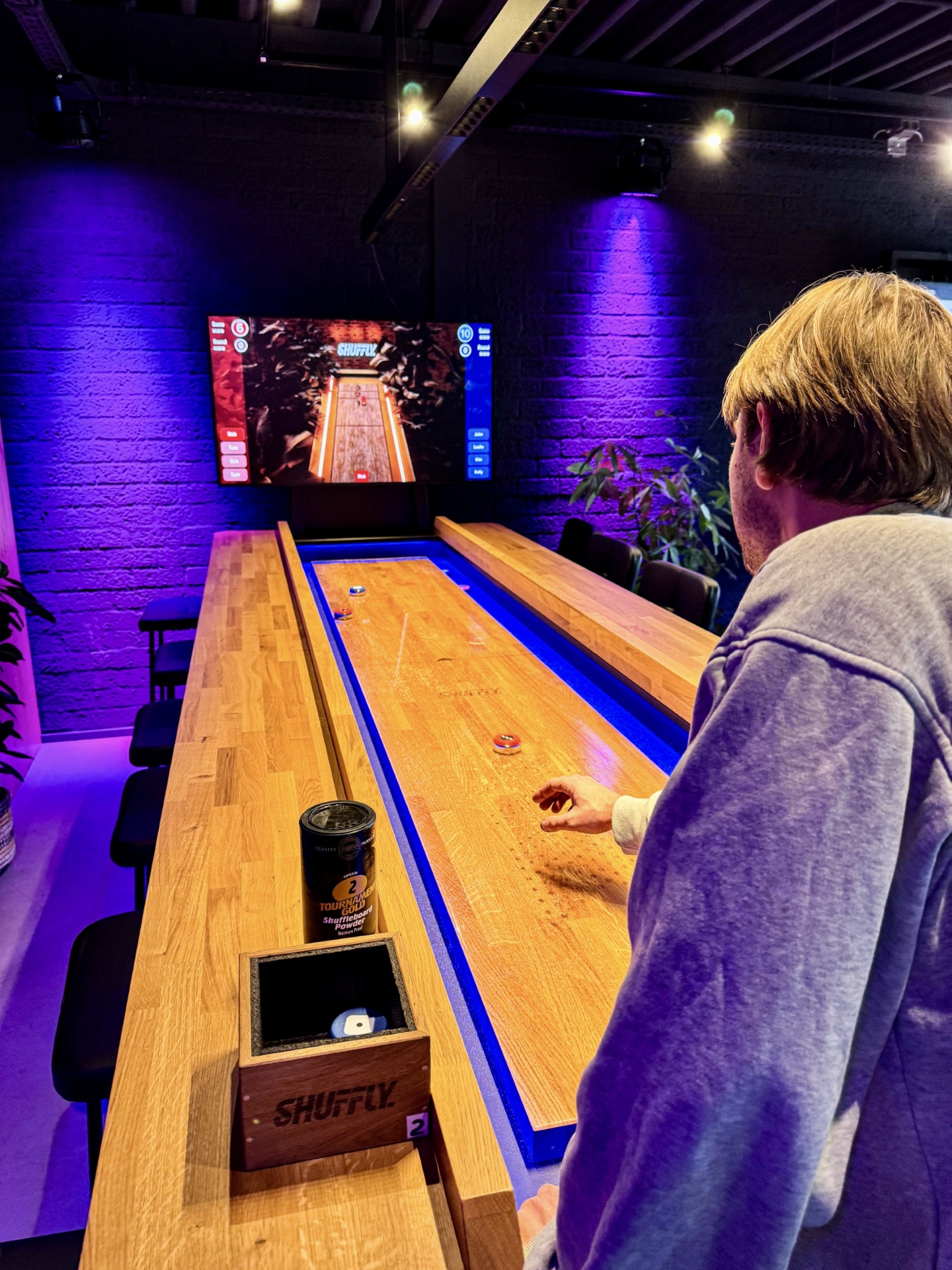
Shuffleboard is a skill and strategy game in which players slide pucks down a long, smooth table toward different scoring zones. The goal is to land your pucks as close as possible to the far end without letting them fall off the table. Shuffleboards come in different lengths and versions, from traditional tables to interactive variants for professional leisure venues.
What is a shuffleboard?
A shuffleboard is a long, flat playing table on which players take turns sliding pucks toward the far end. That end has scoring zones with increasing value. Whoever slides their puck the farthest without it falling off the table scores the most. The game rewards a feel for power and direction, but also tactics: you can knock away your opponent's pucks or shield your own.
When we talk about shuffleboard in this article, we mainly mean table shuffleboard: the version played on a raised wooden table found in bars, bowling centers and leisure venues. There are also two related games that are often confused with shuffleboard.
- Table shuffleboard: played on a long, smooth table with metal pucks that you slide by hand. This is the version Shuffly builds.
- Deck shuffleboard: the outdoor variant, originally from cruise ships, where you push flat discs across the floor with a long cue toward a triangular scoring field.
- Sjoelen (Dutch shuffleboard): the Dutch game with wooden discs that you slide through four gates. The boards are shorter, the discs are made of wood, and the scoring works completely differently.
Shuffleboard is easy to pick up: you can explain the basic rules in a minute. At the same time, there is enough depth to spend entire evenings on it. That combination makes the game appealing to mixed groups, from friends and colleagues to families.
Where does shuffleboard come from?
There is no conclusive evidence about the exact origin of shuffleboard. The most commonly cited account is that the game originated in England centuries ago as a variant of games in which coins or discs were slid across a smooth table or floor. Historical sources are scarce, so we deliberately leave out exact dates and inventors.
What is clear is that the game traveled with ships and emigrants. On board, the deck variant developed, while in North America the table variant grew into a fixture in bars and clubs. From there, table shuffleboard made its way back to Europe, where it has been rapidly gaining popularity again in recent years.
In the Netherlands and Belgium, shuffleboard now appears in bars, bowling centers, family entertainment centers and hotels. The rise of social gaming, where guests play together instead of against a screen, has accelerated that growth.
How does shuffleboard work?
Two players or two teams stand at the same end of the table and take turns sliding a puck to the other side. Each player or team has four pucks in their own color. Once all eight pucks have been played, a round (a frame) is complete and the score is counted.
- Decide who starts; after that, players alternate after every throw.
- Slide the puck by hand; you may not cross the edge of the table when releasing it.
- Let the puck glide as far as possible, but keep it from falling off the table.
- Use your pucks to knock away your opponent's or to shield your own score.
- After eight pucks, count the points, play the next frame from the other end, and continue until the agreed final score.
The playing surface is sprinkled with shuffleboard sand (also called shuffleboard wax). This makes the pucks glide smoothly and predictably. How much sand you use determines how fast the table plays. Experienced players use that to their advantage.
What are the rules?
The rules of table shuffleboard are compact. The basic rules below are used almost everywhere; house rules can vary slightly per venue.
- Each team plays with four pucks in its own color; players throw in turn.
- A puck only counts if it lies completely past the first scoring line.
- Pucks that fall off the table or land in the gutter are out of play for that frame.
- Only the team with the puck lying farthest scores in that frame.
- That team counts all of its own pucks that lie farther than the opponent's best-placed puck.
- The team that scored starts the next frame; play alternates between both ends.
- Play continues to an agreed final score, often 15 or 21 points.
Playing with a mixed group? Agree on the final score beforehand, and whether a puck hanging over the edge (a hanger) counts extra. That avoids discussion halfway through the evening.
How does scoring work?
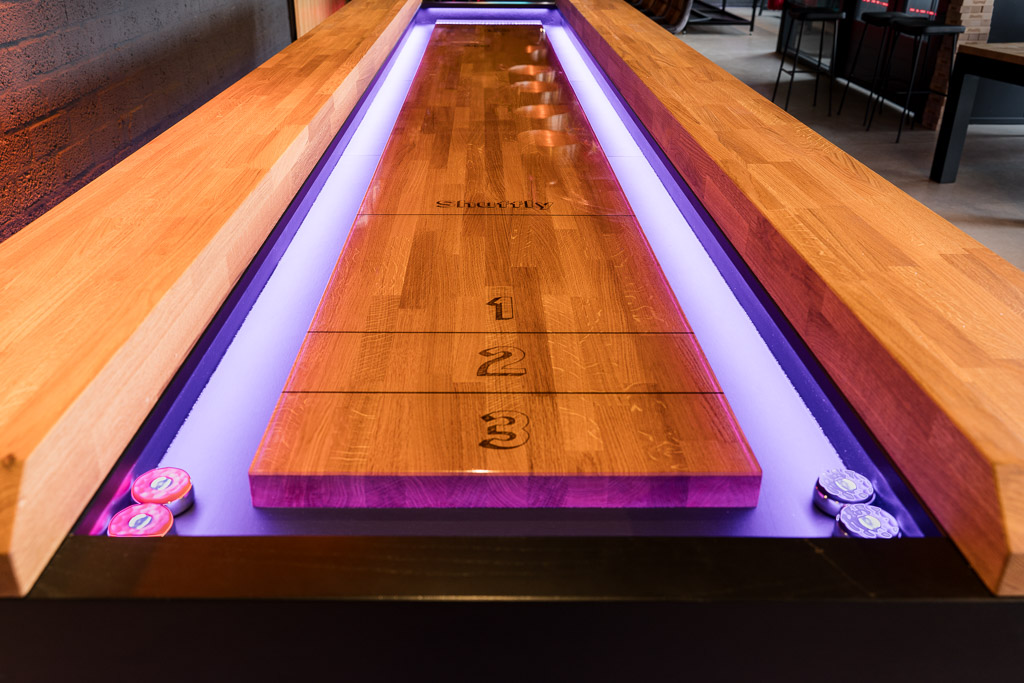
The end of the playing surface is divided into scoring zones with increasing value: usually 1, 2 and 3 points. The closer to the end of the table, the more points. A puck that hangs partly over the edge without falling, known as a hanger, is worth four points in many house rules.
| Zone | Position on the table | Points |
|---|---|---|
| Zone 1 | Just past the first scoring line | 1 |
| Zone 2 | Middle zone | 2 |
| Zone 3 | Last zone before the end | 3 |
| Hanger | Puck hangs over the end edge without falling | 4 (house rule) |
Scoring zones and the value of a hanger can vary by tournament ruleset or venue.
Only one side scores per frame. If your best puck lies farther than your opponent's, all of your pucks that lie even farther count as well. That makes it worthwhile not just to slide far, but also to knock away your opponent or shield your own pucks.
On an interactive shuffleboard, scoring is automatic: the system recognizes the pucks and keeps track of the score on screen. That eliminates discussion and makes the game more accessible for guests who don't yet know the rules.
What does a shuffleboard table consist of?
A professional shuffleboard table is more than a long plank. The quality of the playing surface, the frame and the finish determines how the table plays and how long it lasts in a busy environment.
- Playing surface: a long, flat, lacquered top over which the pucks glide. Flatness and the lacquer layer determine the feel of the game.
- Scoring lines and zones: the markings at both ends on which the scoring is based.
- Gutters: the edges along the playing surface that catch pucks that come off the field.
- Frame and legs: the construction that keeps the table stable and level; often steel in commercial settings.
- Leveling feet: to set the table exactly level, essential for fair play.
- Pucks: two sets of four, in different colors.
- Shuffleboard sand or wax: fine grains that make the playing surface faster and more even.
- Scoreboard: analogue (for example with sliders or chalk) or digital on a screen.
Shuffleboard sand is not real sand and not wax in the classic sense either. It is fine, polished grains (often silicone) that you sprinkle over the playing surface. They reduce friction so the puck glides smoothly. More grains means a faster table, fewer grains a slower one. Topping up and periodically cleaning it is the most important maintenance task for a shuffleboard.
How long and wide is a shuffleboard?
Shuffleboards are traditionally measured in feet. Professional tables typically range from 9 ft to 22 ft. Shuffly delivers 9 ft and 12 ft as standard, the two sizes that in practice fit best with hospitality and leisure venues. The width of our tables is around 76 to 80 cm and the playing height around 83 to 90 cm, depending on the version.
| Size | Length (ft) | Length (cm) | Recommended total space | Suitable for |
|---|---|---|---|---|
| Compact | 9 ft | 274 cm | approx. 474 cm (± 100 cm of playing space at both ends) | Bars, cafes, hotels and spaces with limited floor area |
| Standard | 12 ft | 366 cm | approx. 566 cm (± 100 cm of playing space at both ends) | Bowling centers, FECs, arcades and busy leisure venues |
For verification with Shuffly: exact width, height and weight differ per version (analogue, interactive or custom). Always request the current spec sheet before finalizing the layout of a space. Sizes longer than 12 ft are available on request; those sizes are deliberately left out of this table because they are not standard.
You can find the exact specifications per model on the product pages. View our professional shuffleboards for current dimensions, materials and options.
How much space do you need?
It's not just the table length that matters. Players stand at the ends of the table and need room to move to slide comfortably. Allow about one meter of clear space at both ends. For a 12 ft table, that brings you to a total length of roughly 5.7 meters.
- Keep about 100 cm clear at both ends for players.
- Allow walking space along the long sides for guests and staff, especially in a bar.
- Think about spectators: shuffleboard draws a crowd, so plan space for high tables or stools.
- Make sure the floor is flat and stable; the table is leveled using its adjustable feet.
- For interactive versions, plan for a power supply and, where applicable, a network connection.
Not sure if your space is suitable? Send us your floor plan or dimensions. We're happy to think along about placement and walking routes.
What types of shuffleboards are there?
Roughly speaking, there are three directions: traditional (analogue), interactive and fully custom. They differ in experience, maintenance and how they contribute to your concept.
- Analogue shuffleboard: the classic game with manual scoring. Calm, timeless and a good fit for hotels, restaurants, lounges and bars. View the analogue shuffleboard.
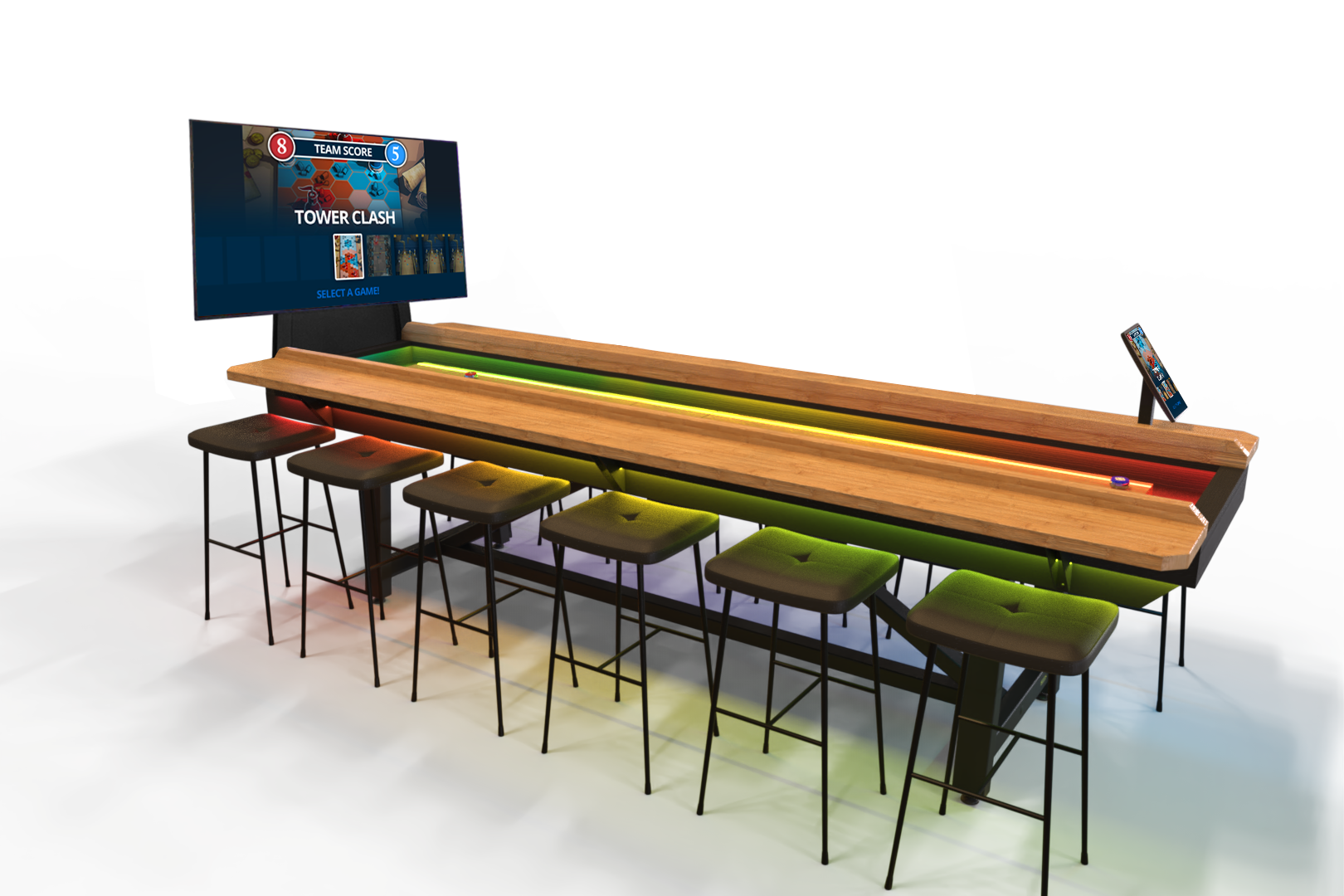
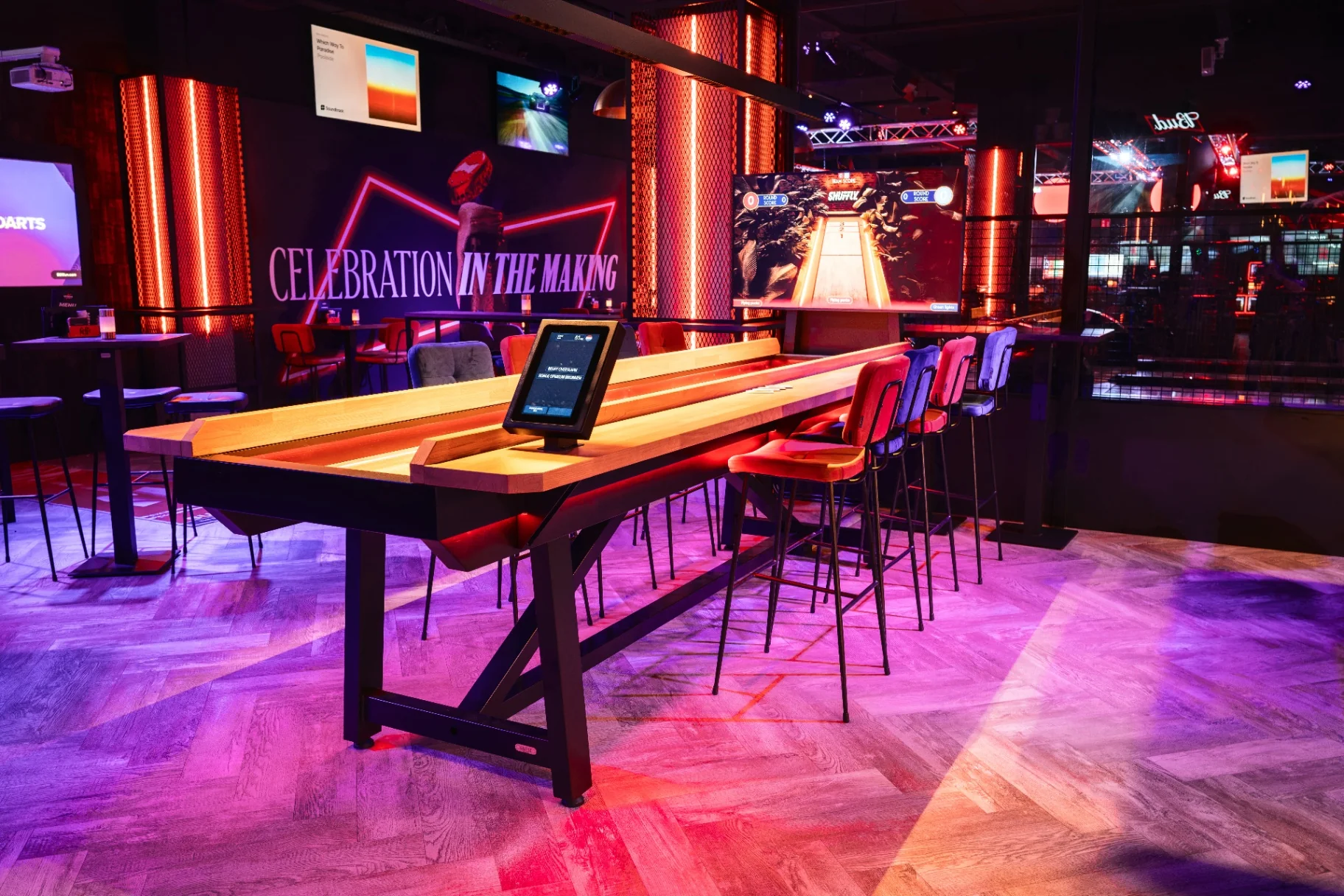
- Interactive shuffleboard: the same table, enhanced with digital game modes, lighting and automatic scoring. Discover how interactive shuffleboard works.
- Custom shuffleboard: a table fully designed around your brand, space and concept, from wood type and color to branding and lighting. View the custom shuffleboard.
Analogue or interactive shuffleboard
The choice between analogue and interactive depends on your guests and your concept. An analogue table is pure gameplay: no screen, no software, no power. An interactive table adds a digital layer that guides and extends the game.
| Analogue | Interactive | |
|---|---|---|
| Scoring | Manual | Automatic |
| Game modes | Classic shuffleboard | Multiple digital game modes |
| Guest instructions | Staff or house rules | On-screen game guidance |
| Experience | Calm and timeless | Dynamic, with visuals and lighting |
| Technology | No power needed | Power and screen required |
| Good fit for | Hotels, restaurants, lounges | FECs, bowling centers, arcades |
Shuffly's interactive shuffleboards add digital game modes, automatic scoring and game guidance, supported by visuals and lighting. For busy venues, that's valuable: guests can start right away without instructions, and staff don't have to explain the rules every time.
Which venues are suitable for shuffleboard?
Shuffleboard works anywhere people come together and spend time. The game is quick to explain, suits mixed groups, and requires relatively little floor space relative to the experience it delivers.
- Bars and cafes: an activity that keeps groups around longer without having to redo the interior.
- Bowling centers: a natural addition to lanes, with the same competitive dynamic.
- Family entertainment centers: suitable for all ages, including as part of packages.
- Arcades: fits into a mix of attractions and lends itself well to pay-per-play.
- Hotels: extra experience in the lobby, bar or lounge area.
- Leisure and event venues: usable for team outings, tournaments and corporate events.
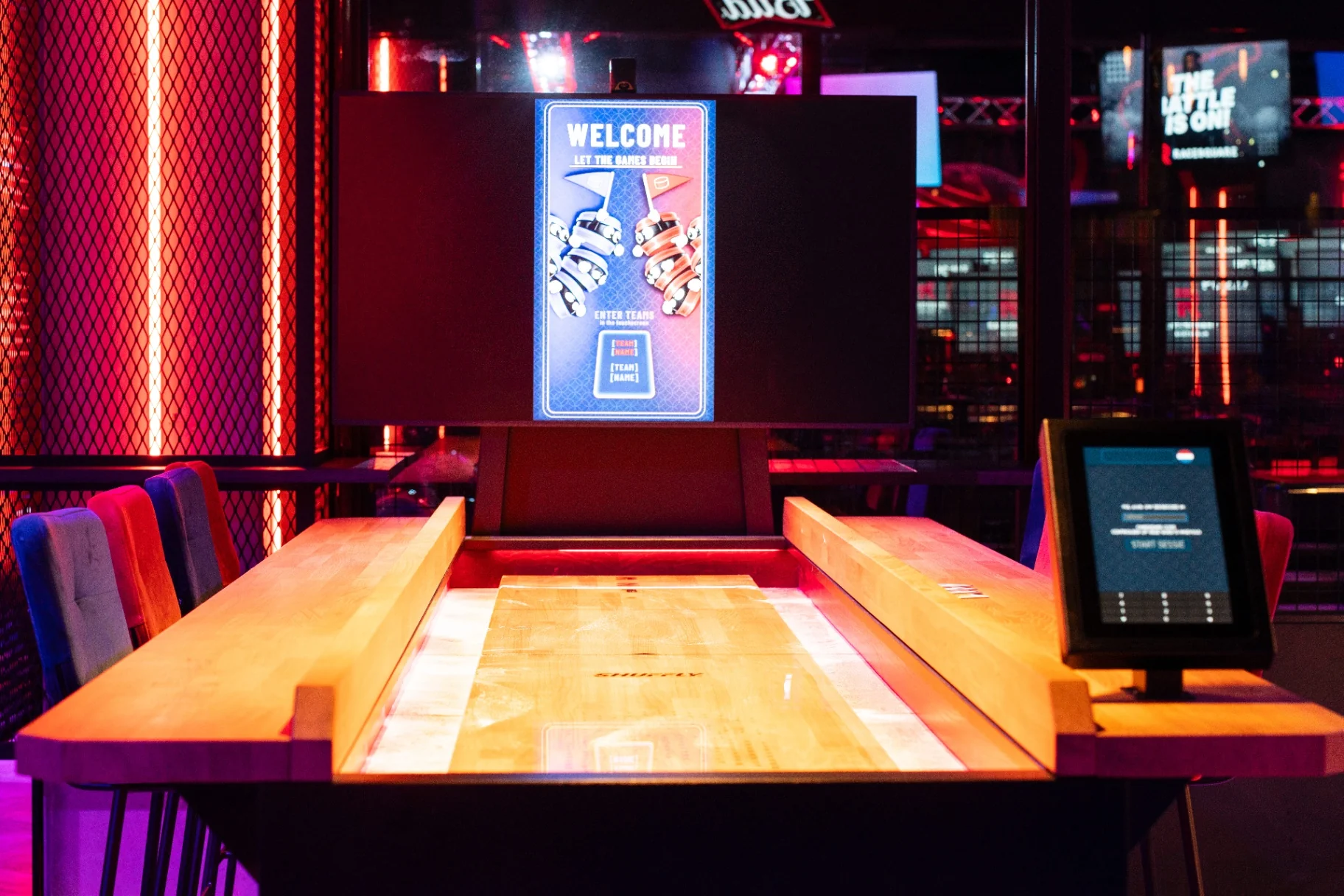
A well-placed shuffleboard can contribute to guest experience, time spent on-site, and therefore revenue per square meter. How big that effect is varies by venue, concept and placement. View completed shuffleboard projects to see how other venues have approached it.
What should you look for when choosing?
A shuffleboard for home use and a shuffleboard for a commercial venue are two different products. In hospitality, a table faces intensive daily use. That places demands on construction, finish and service.
- Space: does the chosen size, including playing space, fit comfortably in your floor plan?
- Audience: do your guests prefer a classic game, or do they expect a digital experience?
- Construction: can the frame withstand intensive use, leaning and knocks?
- Playing surface: flatness and the lacquer layer determine the feel of the game and its lifespan.
- Maintenance: how easy is it to top up sand, clean and carry out periodic maintenance?
- Look and feel: does the table match your interior, or do you want a custom version?
- Operations: do you want to offer free play, or pay-per-game or per time slot?
- Service and warranty: who supplies, installs and maintains it, and how quickly is support available?
Not sure yet which version fits? Get advice for your venue. We're happy to think along about space, concept and goals.
How do you maintain a shuffleboard?
Shuffleboards are easy to maintain, but not maintenance-free. With a fixed routine, the playing surface stays fast and even, and the table lasts for years.
- Top up shuffleboard sand regularly; the frequency depends on how intensively the table is used.
- Sweep the playing surface periodically so old sand, dust and drink residue don't build up.
- Clean the pucks; dirty pucks glide unevenly and can damage the lacquer layer over time.
- Check occasionally with a level that the table is still flat and adjust the leveling feet if needed.
- Prevent guests from placing glasses on the playing surface; moisture is the biggest enemy of a wooden playing surface.
- Keep the table out of direct sunlight and away from strong temperature or humidity changes.
For interactive tables, software maintenance is added, such as updates and checking the detection system. That is arranged in consultation during installation.
Frequently asked questions
Was this information helpful?
You might also find this interesting
Interactive shuffleboard
Digital game modes, automatic scoring and game guidance in one table.
View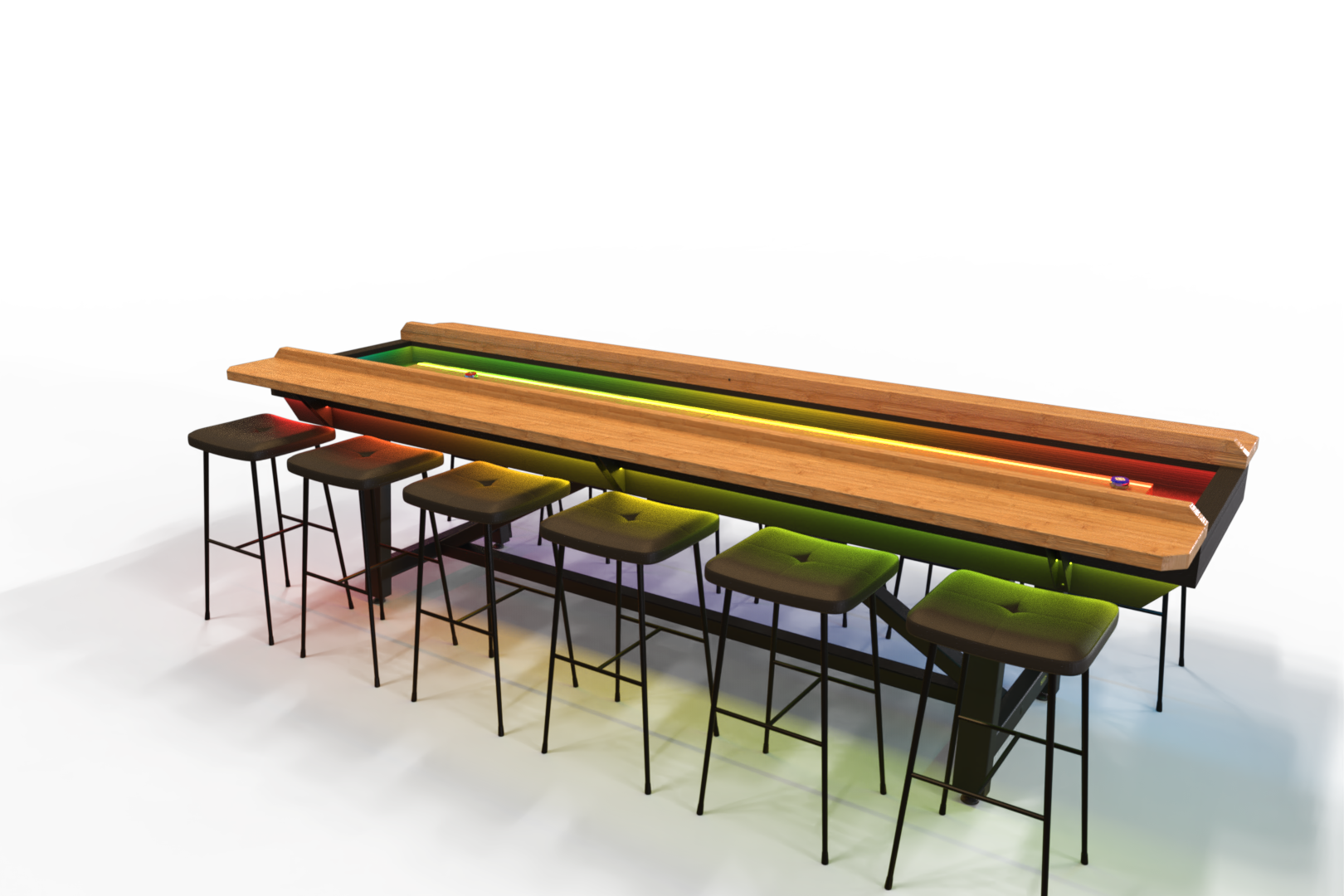
Completed projects
See venues that use Shuffly for experience and revenue per square meter.
View